$140.00
Description
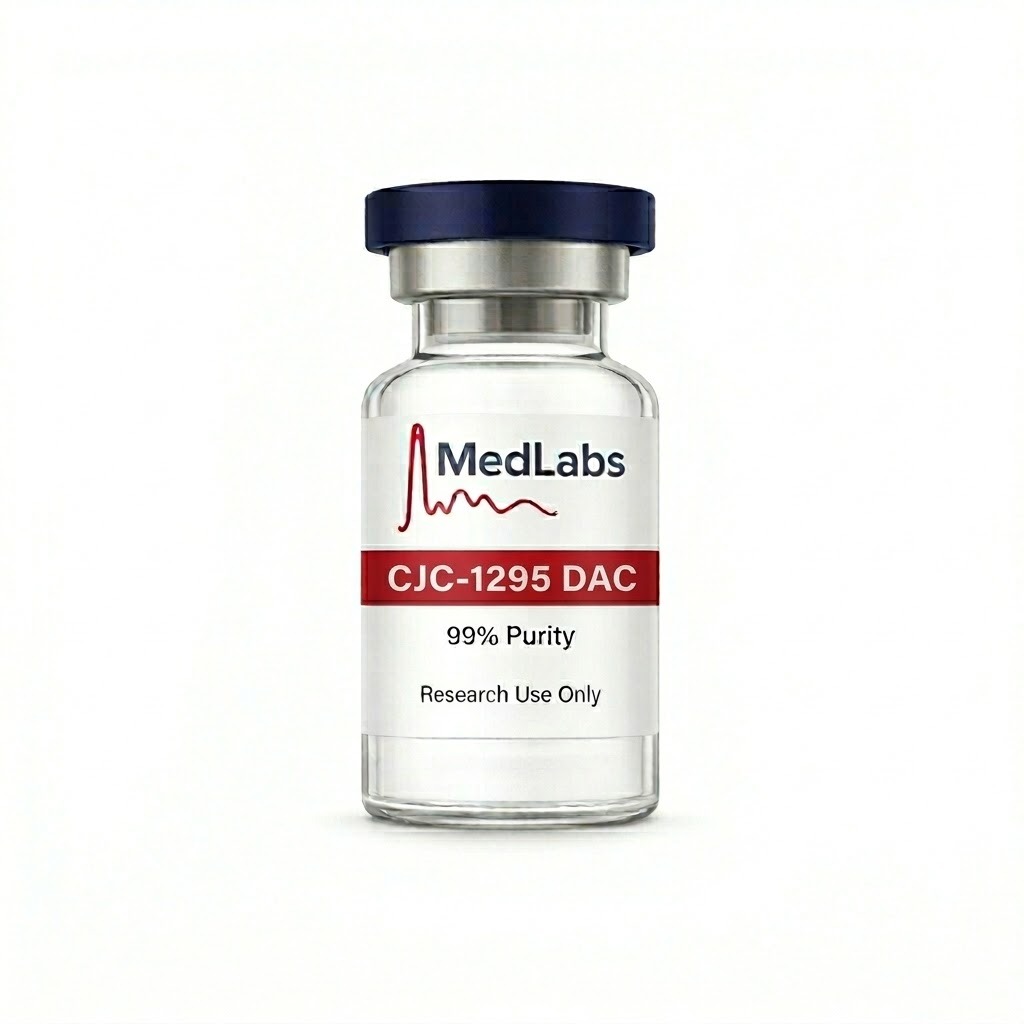
CJC-1295 DAC is a long-acting synthetic analog of growth hormone-releasing hormone (GHRH) specifically engineered with a Drug Affinity Complex (DAC) that extends its plasma half-life to approximately 6-8 days. Unlike standard GHRH peptides that are cleared within minutes, CJC-1295 DAC peptide binds to serum albumin, creating a sustained-release profile that maintains elevated growth hormone (GH) and insulin-like growth factor 1 (IGF-1) levels for extended periods making it ideal for research protocols requiring consistent, long-duration GH axis stimulation without daily injections.
Key Benefits of CJC-1295 DAC Peptide
Extended Half-Life & Sustained GH Release
The defining feature of CJC-1295 DAC is the Drug Affinity Complex a protective moiety attached via a lysine linker that enables the peptide to bind reversibly to serum albumin. This bioconjugation technology extends the peptide‘s presence in circulation dramatically. Clinical pharmacokinetic studies have demonstrated that a single subcutaneous injection of CJC-1295 DAC produces dose-dependent increases in mean plasma GH concentrations by 2- to 10-fold for 6 days or more, and elevates IGF-1 levels by 1.5- to 3-fold for 9-11 days. After multiple doses, mean IGF-1 levels remained above baseline for up to 28 days. For researchers requiring stable, long-term GH axis activation without the variability of daily pulsatile dosing, CJC-1295 DAC offers unparalleled convenience and consistency.
Enhanced Muscle Recovery & Protein Synthesis
CJC-1295 DAC stimulates the anterior pituitary gland to release endogenous growth hormone, which in turn drives hepatic production of IGF-1 a critical mediator of muscle protein synthesis, tissue repair, and cellular regeneration. Research indicates that sustained GH elevation supports accelerated recovery from muscle damage, improved nitrogen retention, and enhanced lean tissue preservation during catabolic states. The prolonged signaling duration of CJC-1295 with DAC creates an extended anabolic window that may benefit studies examining muscle hypertrophy, injury rehabilitation, and age-related sarcopenia models.
Fat Metabolism & Body Composition
Growth hormone is a potent regulator of lipolysis, promoting the breakdown of stored triglycerides and shifting substrate utilization toward fatty acid oxidation. By maintaining consistently elevated GH and IGF-1 levels, CJC-1295 DAC peptide supports enhanced metabolic rate and fat mobilization in research subjects. Studies on GHRH analogs demonstrate significant reductions in visceral and subcutaneous adipose tissue, making CJC-1295 DAC particularly valuable for body composition research, metabolic disorder studies, and protocols examining the GH/IGF-1 axis in obesity models.
Improved Sleep Architecture & Recovery
GH secretion is intimately linked to sleep quality, particularly slow-wave (deep) sleep phases. CJC-1295 DAC research protocols have noted improvements in REM sleep duration and reduced nocturnal awakenings, likely mediated through the peptide‘s sustained GH elevation and downstream effects on neurotransmitter balance and circadian rhythm regulation. Enhanced sleep quality translates to superior recovery capacity, cognitive restoration, and optimized hormonal milieu critical variables in comprehensive research protocols examining performance and well-being.
Convenient Weekly Dosing Protocol
The extended pharmacokinetic profile of CJC-1295 DAC eliminates the need for multiple daily injections required by short-acting GHRH analogs like Mod GRF 1-29 (CJC-1295 without DAC). Research protocols typically utilize once-weekly subcutaneous administration, significantly reducing handling frequency while maintaining continuous GH elevation. This convenience factor minimizes stress variables in research subjects and simplifies long-term study logistics.
CJC-1295 DAC vs. CJC-1295 Without DAC: Technical Comparison
| Feature | CJC-1295 DAC | CJC-1295 No DAC (Mod GRF 1-29) |
|---|---|---|
| Half-Life | 6-8 days | ~30 minutes |
| Release Pattern | Sustained, continuous | Brief, pulsatile |
| Dosing Frequency | Once weekly | 1-3 times daily |
| GH Elevation Duration | 6+ days per dose | 30-60 minutes per dose |
| Albumin Binding | Yes (via DAC moiety) | No |
| Primary Research Application | Long-duration GH/IGF-1 studies | Pulsatile GH release studies |
| Typical Research Dose | 1-2 mg weekly (or 30-100 mcg/kg) | 100-300 mcg per injection |
The DAC moiety fundamentally alters the peptide‘s pharmacological behavior. By enabling reversible albumin binding, CJC-1295 DAC transforms a rapidly cleared GHRH analog into a sustained-release therapeutic candidate suitable for studies requiring stable, long-term GH axis modulation
Research Applications & Protocols
Primary Research Areas
-
Growth hormone deficiency models
-
IGF-1 elevation and metabolic studies
-
Muscle hypertrophy and recovery protocols
-
Adipose tissue reduction and body composition analysis
-
Age-related GH decline (somatopause) research
-
Sleep architecture and recovery optimization
-
Bone density and connective tissue regeneration studies
Recommended Research Dosage Guidelines
Based on published clinical data, the following dosing parameters serve as reference points for research protocol design:
Weight-Based Dosing:
-
30-60 mcg per kg of body weight, administered subcutaneously once weekly
-
30-100 mcg per kg weekly range documented in research literature
Fixed Dosing Approach:
-
1-2 mg administered subcutaneously once weekly
-
Starting research dose: 500 mcg – 1 mg weekly for initial assessment
Cycle Duration:
-
Standard research protocols: 8-12 weeks
-
Extended studies: up to 16-20 weeks with appropriate washout periods
Reconstitution & Storage Guidelines
Proper reconstitution technique is essential for maintaining peptide integrity:
-
Reconstitution Volume: Mix 2 mL of bacteriostatic water with a 5 mg vial of CJC-1295 DAC powder. This creates a concentration of 2.5 mg/mL for precise dosing calculations.
-
Injection Technique: Direct the bacteriostatic water stream gently against the vial wall at an angle to minimize foaming and prevent peptide degradation from agitation.
-
Storage: Reconstituted CJC-1295 DAC solution must be refrigerated at 2-8°C (35-46°F) and protected from light. Use within 30 days for optimal stability.
-
Lyophilized Powder: Unreconstituted vials should be stored at -20°C for long-term preservation (up to 24 months). Brief room temperature exposure during reconstitution is acceptable.
Synergistic Research Combinations
CJC-1295 DAC is frequently studied in combination with complementary peptides to enhance research outcomes:
-
Ipamorelin: A selective ghrelin receptor agonist that synergizes with GHRH analogs to produce amplified GH pulses. When combined with CJC-1295 DAC, researchers observe enhanced total GH output.
-
GHRP-2 or GHRP-6: Growth hormone-releasing peptides that complement sustained GHRH stimulation with acute GH pulses.
-
BPC-157: For protocols examining combined tissue repair and systemic GH elevation.
Frequently Asked Questions: CJC-1295 DAC Peptide
What is CJC-1295 DAC and how does the DAC component work?
CJC-1295 DAC is a tetrasubstituted analog of growth hormone-releasing hormone (GHRH) consisting of the first 29 amino acids of GHRH modified with a Drug Affinity Complex (DAC) at the C-terminus via a lysine linker. The DAC moiety contains a reactive maleimide group that selectively binds to the free thiol on cysteine-34 of serum albumin the most abundant protein in blood circulation. This bioconjugation protects the peptide from rapid proteolytic degradation and renal clearance, extending its half-life from approximately 30 minutes (without DAC) to 6-8 days. The albumin-bound CJC-1295 DAC complex remains bioactive, continuously activating GHRH receptors on pituitary somatotrophs to stimulate sustained GH secretion.
How long does CJC-1295 DAC remain active in research subjects?
Clinical pharmacokinetic studies demonstrate that CJC-1295 DAC has an estimated plasma half-life of 5.8-8.1 days in healthy adults. A single subcutaneous dose produces measurable GH elevation for 6 days or more and IGF-1 elevation for 9-11 days. With weekly or biweekly dosing, IGF-1 levels remain consistently above baseline for up to 28 days post-administration. This extended duration makes CJC-1295 DAC uniquely suited for research protocols requiring stable, long-term GH/IGF-1 axis stimulation without the variability of daily injections.
What are the primary benefits of CJC-1295 DAC in research?
CJC-1295 DAC research focuses on four core pathways:
-
Sustained GH and IGF-1 Elevation: Dose-dependent increases in GH (2-10× baseline) and IGF-1 (1.5-3× baseline) for extended durations.
-
Muscle Protein Synthesis: Enhanced nitrogen retention, accelerated tissue repair, and improved lean mass preservation through IGF-1-mediated anabolic signaling.
-
Adipose Tissue Reduction: Increased lipolysis and fatty acid oxidation, supporting metabolic research and body composition studies.
-
Recovery Optimization: Improved sleep architecture, enhanced tissue regeneration, and accelerated post-exercise recovery parameters.
What is the recommended CJC-1295 DAC dosage for research protocols?
Research dosage guidelines derived from published literature include:
Weight-Based Dosing: 30-60 mcg per kg of body weight, administered subcutaneously once weekly. This range was validated in randomized, double-blind, placebo-controlled trials as safe and well-tolerated while producing significant GH and IGF-1 elevations.
Fixed Dosing: 1-2 mg administered subcutaneously once weekly for research subjects of average body weight.
Starting Research Dose: 500 mcg – 1 mg weekly for initial tolerance assessment, with gradual titration based on observed response.
Always design research protocols with appropriate control groups and baseline measurements for valid data interpretation.
How should CJC-1295 DAC be reconstituted and stored?
Follow these standardized reconstitution procedures:
Reconstitution: Add 2 mL of bacteriostatic water to a 5 mg vial of CJC-1295 DAC powder. Direct the water stream gently against the vial wall to minimize foaming and peptide aggregation. Do not shake vigorously.
Concentration Calculation: With 5 mg in 2 mL, each 0.1 mL (10 units on insulin syringe) contains 250 mcg. For 1 mg dose, draw 0.4 mL (40 units).
Storage: Refrigerate reconstituted solution at 2-8°C, protected from light. Use within 30 days. Store lyophilized powder at -20°C for long-term preservation (up to 24 months).
What side effects or safety considerations apply to CJC-1295 DAC research?
Clinical trial data indicates that CJC-1295 DAC was safe and relatively well-tolerated in healthy adults, particularly at doses of 30 or 60 mcg/kg. No serious adverse reactions were reported in published studies. Documented side effects may include:
-
Mild injection site reactions (redness, swelling)
-
Temporary water retention
-
Headache or fatigue
-
Mild joint discomfort (rare)
Research subjects should be monitored for any adverse responses, and protocols should include appropriate washout periods between cycles.
Can CJC-1295 DAC be combined with other peptides like Ipamorelin?
Yes, CJC-1295 DAC is frequently studied in combination with Ipamorelin, a selective ghrelin receptor agonist. The theoretical synergy derives from complementary mechanisms: CJC-1295 DAC provides sustained GHRH receptor activation, while Ipamorelin stimulates ghrelin receptors to amplify GH release without significant appetite stimulation or cortisol elevation. Research protocols often combine weekly CJC-1295 DAC with daily Ipamorelin injections to maximize total GH output while maintaining the convenience of less frequent GHRH analog dosing.
What is the difference between CJC-1295 DAC and CJC-1295 without DAC?
The critical distinction lies in the DAC moiety:
CJC-1295 DAC: Contains the Drug Affinity Complex, enabling albumin binding and a 6-8 day half-life. Produces sustained, continuous GH elevation with once-weekly dosing.
CJC-1295 No DAC (Mod GRF 1-29): Lacks the DAC moiety, resulting in a ~30-minute half-life and rapid clearance. Produces brief, pulsatile GH release requiring 1-3 daily injections.
Clinical Note: CJC-1295 without DAC is technically a different compound (Modified GRF 1-29). The original patented CJC-1295 molecule included the DAC component. The no-DAC version was developed later for researchers seeking pulsatile rather than sustained GH stimulation.
How long does a typical CJC-1295 DAC research cycle last?
Standard research protocols range from 8-12 weeks, with some studies extending to 16-20 weeks. The cumulative effects of CJC-1295 DAC build over multiple weeks due to its extended half-life and progressive IGF-1 elevation. Researchers should incorporate:
-
Baseline Measurements: GH, IGF-1, body composition, and metabolic markers before initiating protocol
-
Mid-Cycle Assessment: Monitor response and adjust dosing if indicated
-
Post-Cycle Evaluation: Measure outcomes and allow appropriate washout period before subsequent cycles
Extended cycles (>12 weeks) may require periodic assessment of insulin sensitivity and glucose metabolism.
Additional information
| Strength | 5mg |
|---|
Related products
-
Ipamorelin
Price range: $40.00 through $60.00 Read more -
PEG-MGF
$100.00 Read more -
Buy GHRP-2 Online
$60.00 Read more -
Hexarelin
$95.00 Select options This product has multiple variants. The options may be chosen on the product page
Reviews
There are no reviews yet.