Price range: $80.00 through $325.00
Description
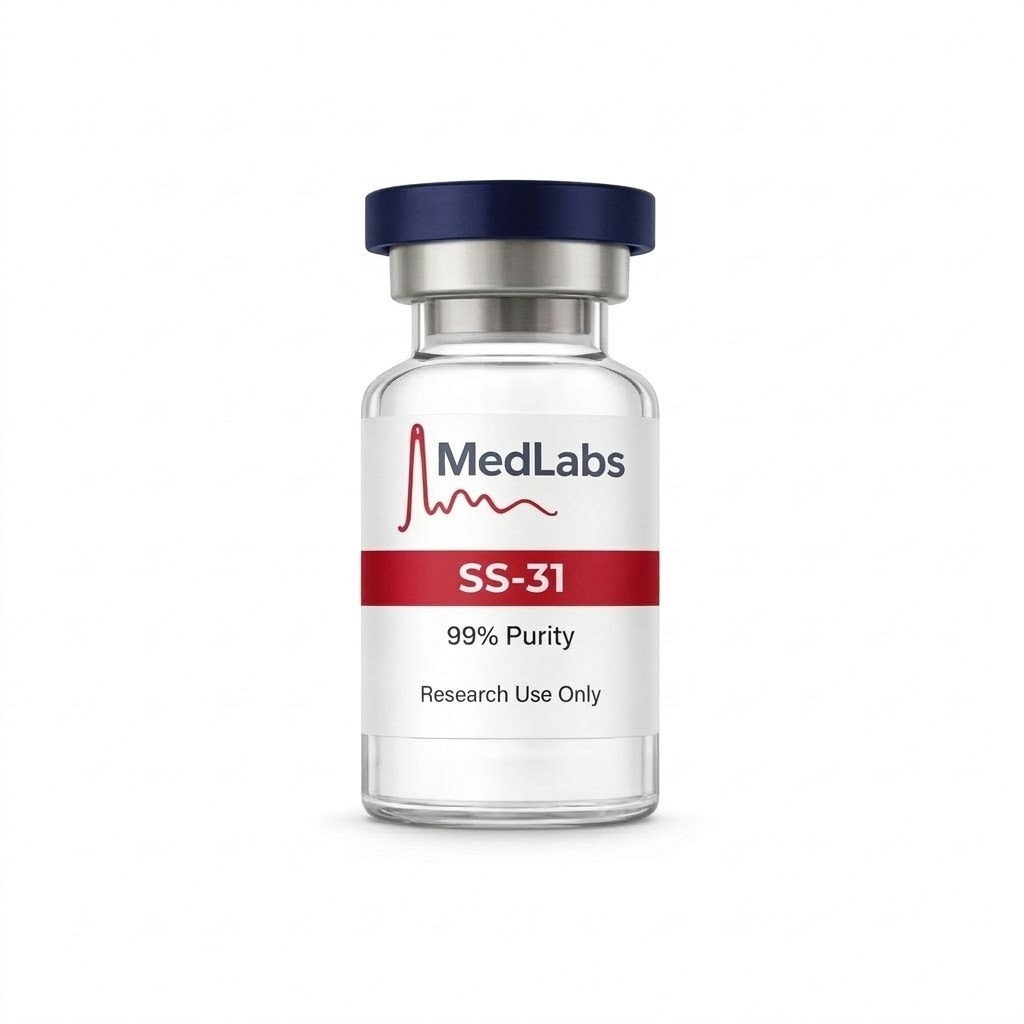
SS-31 Dosing Complete Research Guide and Premium Mitochondrial Peptide From Peptide Steroids
Product Introduction
Understanding correct SS-31 dosing is essential for any researcher working with this groundbreaking mitochondria-targeted tetrapeptide. SS-31 (also known as Elamipretide, Bendavia, or MTP-131) is a synthetic peptide consisting of the sequence D-Arg-Dmt-Lys-Phe-NH2 that selectively concentrates in the inner mitochondrial membrane by binding to cardiolipin a phospholipid critical to electron transport chain function and cellular energy production.
At Peptide Steroids, we provide the most comprehensive SS-31 dosing documentation alongside 99%+ pure, research-grade SS-31 peptide verified through independent HPLC and Mass Spectrometry testing. Whether you are investigating cardiac ischemia-reperfusion injury, acute kidney injury, neurodegenerative mitochondrial dysfunction, or age-related bioenergetic decline, accurate SS-31 dosing is the foundation of reproducible results.
Understanding SS-31 Dosing Mechanism of Action
Before establishing an SS-31 dosing protocol, researchers must understand how SS-31 works at the molecular level. Unlike conventional antioxidants that distribute broadly throughout the cell, SS-31 achieves a concentration in mitochondria that is approximately 1,000 to 5,000 times greater than its extracellular concentration. This extraordinary selectivity is what makes SS-31 dosing so effective even at low quantities.
The mechanism of action relevant to SS-31 dosing research:
- SS-31 penetrates the cell membrane due to its alternating aromatic-cationic motif
- It selectively accumulates in the inner mitochondrial membrane by binding to cardiolipin
- This interaction stabilizes cytochrome c in its electron carrier function
- Electron transport chain efficiency is improved and electron leak is reduced
- Reactive oxygen species (ROS) production decreases at the source rather than being scavenged downstream
- ATP production is restored toward optimal levels
- Mitochondrial membrane potential is stabilized, preventing permeability transition pore opening and apoptotic signaling
This mechanism explains why SS-31 dosing at relatively low concentrations produces significant biological effects the peptide works at the precise location where mitochondrial dysfunction originates.
SS-31 Dosing Research Protocols From Published Studies
The following SS-31 dosing data is compiled from peer-reviewed publications and clinical trials. All dosing information is provided strictly for research reference purposes. SS-31 is not approved for human therapeutic use.
H3: SS-31 Dosing in Preclinical Animal Studies
| Research Model | SS-31 Dosing Protocol | Route | Key Findings | Reference |
|---|---|---|---|---|
| Cardiac Ischemia-Reperfusion (Mouse) | 3 mg/kg | Intraperitoneal (IP) | Reduced infarct size by 50-60% | Szeto, 2008 |
| Acute Kidney Injury (Rat) | 2 mg/kg | Subcutaneous (SC) | Protected renal tubular mitochondria and reduced serum creatinine | Birk et al., 2013 |
| Skeletal Muscle Aging (Mouse) | 3 mg/kg/day for 8 weeks | IP | Restored age-related decline in mitochondrial energetics | Siegel et al., 2013 |
| Heart Failure (Dog) | 0.05 mg/kg/hr infusion | Intravenous (IV) | Improved left ventricular function and cardiac output | Sabbah et al., 2016 |
| Neurodegeneration (Mouse) | 5 mg/kg | IP | Reduced oxidative damage and improved neuronal survival | Yang et al., 2009 |
| Diabetic Cardiomyopathy (Mouse) | 3 mg/kg/day | IP | Attenuated cardiac fibrosis and diastolic dysfunction | Dai et al., 2014 |
SS-31 Dosing in Human Clinical Trials
| Clinical Trial | SS-31 Dosing Protocol | Route | Condition | Status |
|---|---|---|---|---|
| EMBRACE Trial | 0.25 mg/kg single dose | IV Infusion | ST-Elevation Myocardial Infarction (STEMI) | Phase 2 Completed |
| ReCLAIM Trial | 40 mg/day | SC Injection | Age-Related Macular Degeneration (AMD) | Phase 2 Completed |
| MMPOWER-3 Trial | 40 mg/day | SC Injection | Primary Mitochondrial Myopathy (Barth Syndrome) | Phase 3 |
| PROGRESS Trial | 4 mg single dose | IV Infusion | Renal Ischemia-Reperfusion | Phase 2 |
These published SS-31 dosing protocols demonstrate that effective doses vary significantly depending on the research model, route of administration, and target organ system.
SS-31 Dosing Key Factors That Influence Protocol Design
When establishing an SS-31 dosing protocol for your specific research application, the following variables must be considered:
- Route of Administration: Published SS-31 dosing research utilizes intraperitoneal (IP), subcutaneous (SC), and intravenous (IV) routes. SC injection is most common in chronic dosing studies while IV infusion is used for acute interventions.
- Species and Body Weight: Preclinical SS-31 dosing in rodent models typically ranges from 2-5 mg/kg. Canine models use lower doses around 0.05 mg/kg/hr. Human clinical trials have used fixed doses of 4-40 mg or weight-based doses of 0.25 mg/kg.
- Acute vs Chronic Administration: Single-dose SS-31 dosing protocols are used in ischemia-reperfusion studies while chronic daily dosing over weeks to months is employed in aging and degenerative disease models.
- Target Organ System: Cardiac and renal SS-31 dosing studies generally use 2-3 mg/kg in rodents. Neurodegeneration models may use higher doses up to 5 mg/kg. Ophthalmic research in humans has used 40 mg/day subcutaneously.
- Timing Relative to Injury: In ischemia-reperfusion research, SS-31 dosing is most effective when administered 30 minutes before reperfusion or at the time of reperfusion onset.
For detailed reconstitution and preparation instructions relevant to your SS-31 dosing protocol, visit our Peptide Reconstitution Guide
SS-31 Dosing Product Specifications From Peptide Steroids
| Specification | Details |
|---|---|
| Product Name | SS-31 (Elamipretide) |
| Alternative Names | Bendavia, MTP-131 |
| Sequence | D-Arg-Dmt-Lys-Phe-NH2 |
| Molecular Formula | C32H49N9O5 |
| Molecular Weight | 639.78 g/mol |
| Purity | 99%+ (HPLC and Mass Spec Verified) |
| Form | Lyophilized (Freeze-Dried) Powder |
| Appearance | White to off-white powder |
| Solubility | Freely soluble in sterile water and bacteriostatic water |
| Storage Pre-Reconstitution | -20°C protected from light |
| Storage Post-Reconstitution | 2-8°C use within 21 days |
| Available Sizes | 5mg, 10mg, 20mg, 50mg |
| COA Included | Yes — third-party HPLC and MS verification for every batch |
SS-31 Dosing Who Is This Product For?
Researchers who need accurate SS-31 dosing data and a verified source of SS-31 peptide span multiple disciplines. This product is designed for mitochondrial biologists studying electron transport chain dysfunction, cardiologists investigating ischemia-reperfusion injury models, nephrologists researching acute and chronic kidney injury, neuroscientists studying mitochondrial contributions to neurodegeneration, and aging researchers examining bioenergetic decline in senescent tissues.
A typical use case involves a cardiovascular research laboratory establishing an SS-31 dosing protocol of 3 mg/kg IP in a murine ischemia-reperfusion model to quantify infarct size reduction and mitochondrial membrane potential preservation. Another common scenario involves an aging biology lab administering daily SS-31 dosing over 8 weeks to assess restoration of skeletal muscle mitochondrial function in aged mice.
This product is sold strictly for research and laboratory use. It is not intended for human consumption, veterinary use, or diagnostic purposes.
SS-31 Dosing How to Order From Peptide Steroids
Ordering your SS-31 peptide with complete SS-31 dosing documentation from Peptide Steroids is fast and secure:
- Select your preferred vial size 5mg, 10mg, 20mg, or 50mg
- Add to cart and proceed to secure checkout
- Pay via credit card, cryptocurrency, or bank wire transfer
- Receive your tracking number within hours of same-day processing
We ship to the USA, Canada, United Kingdom, Europe, and Australia.
SS-31 Dosing Related Research Compounds From Peptide Steroids
Researchers studying SS-31 dosing frequently investigate these complementary mitochondrial and cellular health compounds:
- Buy MOTS-c Peptide Mitochondrial-derived peptide studied for metabolic regulation and exercise mimetic effects
- Buy Humanin Peptide Mitochondrial-derived peptide investigated for cytoprotection and neuroprotection
- Buy Epithalon Telomerase-activating tetrapeptide for longevity and anti-aging research
- Buy GHK-Cu Peptide Copper tripeptide for tissue remodeling and mitochondrial gene expression
- Buy FOXO4 Peptide Senolytic peptide for clearing senescent cells with dysfunctional mitochondria
FAQ SS-31 Dosing
Q: What is the correct SS-31 dosing for research applications?
A: SS-31 dosing varies based on the research model, target organ, and route of administration. Published preclinical studies typically use 2-5 mg/kg administered intraperitoneally or subcutaneously in rodent models. Human clinical trials have used fixed doses of 4-40 mg intravenously or subcutaneously. Peptide Steroids provides detailed SS-31 dosing reference documentation compiled from peer-reviewed literature with every order.
Q: What is the difference between SS-31 and Elamipretide?
A: SS-31 and Elamipretide refer to the same compound. SS-31 is the original research designation given by Dr. Hazel Szeto and Dr. Peter Bhatt who developed the Szeto-Schiller (SS) peptide series. Elamipretide is the International Nonproprietary Name (INN) assigned for clinical development. Bendavia and MTP-131 are additional names used in clinical trial registrations. All SS-31 dosing data applies equally regardless of which name is used.
Q: How should I reconstitute SS-31 peptide for my SS-31 dosing protocol?
A: Add bacteriostatic water or sterile water slowly along the inside wall of the SS-31 vial. Gently swirl until fully dissolved. Do not shake or vortex. Calculate your concentration based on the amount of water added relative to the peptide mass in the vial. For example, adding 1 mL of water to a 5 mg vial produces a 5 mg/mL solution. Adjust your injection volume according to your specific SS-31 dosing protocol. Store reconstituted SS-31 at 2-8°C and use within 21 days.
Q: Why does SS-31 dosing work at such low concentrations compared to other antioxidants?
A: SS-31 dosing is effective at low concentrations because the peptide concentrates in mitochondria at 1,000 to 5,000 times its extracellular concentration. Unlike conventional antioxidants that distribute throughout the entire cell and require high systemic doses, SS-31 accumulates precisely at the inner mitochondrial membrane by binding to cardiolipin. This targeted delivery means that lower SS-31 dosing achieves higher effective concentrations at the site of action.
Q: Is it legal to purchase SS-31 peptide?
A: Yes, SS-31 peptide is legal to purchase for legitimate laboratory research purposes in most countries. It is classified as a research chemical and is not approved by the FDA for human therapeutic use. Peptide Steroids sells SS-31 strictly for research applications with complete SS-31 dosing documentation to support your scientific protocols.
Additional information
| Strength | 10mg, 50mg |
|---|
Related products
-
buy humanin peptide
$260.00 Select options This product has multiple variants. The options may be chosen on the product page -
Buy VIP Peptide Research-Grade
Read more -
Buy MOTS-c Peptide Online
Price range: $50.00 through $180.00 Select options This product has multiple variants. The options may be chosen on the product page -
FOX04
$275.00 Select options This product has multiple variants. The options may be chosen on the product page
Reviews
There are no reviews yet.