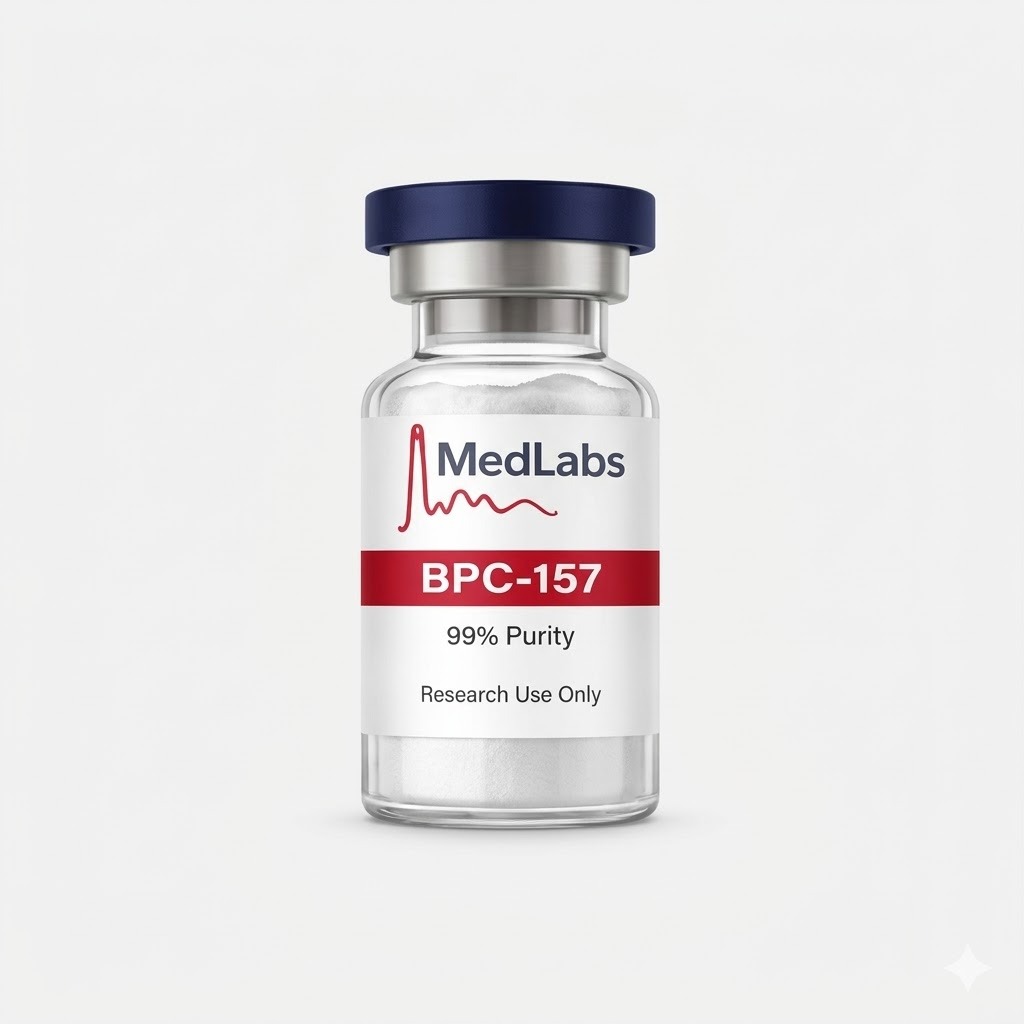
Price range: $35.00 through $70.00
Description
BPC 157 Peptide: Research-Grade Body Protection Compound for Tissue Repair & Recovery
BPC 157 peptide short for Body Protection Compound-157 is a synthetic pentadecapeptide derived from a naturally occurring protein found in human gastric juice. Composed of 15 amino acids (Gly-Glu-Pro-Pro-Pro-Gly-Lys-Pro-Ala-Asp-Asp-Ala-Gly-Leu-Val), BPC 157 has emerged as one of the most extensively studied regenerative peptides in modern preclinical research. With over 30 years of published animal studies and mounting interest from sports medicine clinicians, BPC 157 is investigated for its role in musculoskeletal healing, gut mucosal protection, angiogenesis, and neuroprotection.
If you are new to research peptides, our beginner’s guide to research peptides explains how these compounds are classified, sourced, and used in scientific settings.
What Is BPC 157? Origins and Chemical Profile
Body Protection Compound (BPC) was first isolated from human gastric juice, where it plays a role in maintaining mucosal integrity and gastrointestinal homeostasis. Researchers identified a stable 15-amino-acid fragment — BPC 157 — that retained the full biological activity of the parent compound while offering superior stability. Unlike many peptides, BPC 157 remains intact in human gastric juice for over 24 hours, making it uniquely stable for both oral and injectable research applications.
| Property | Detail |
|---|---|
| Full name | Body Protection Compound-157 |
| Also known as | Pentadecapeptide BPC 157, PL-10, PLD-116, PL 14736 |
| Amino acid sequence | Gly-Glu-Pro-Pro-Pro-Gly-Lys-Pro-Ala-Asp-Asp-Ala-Gly-Leu-Val |
| Molecular weight | 1,419 Da |
| Origin | Derived from human gastric juice protein BPC (MW 40,000) |
| Key pathways | VEGFR2 / FAK-paxillin / JAK-2 / Egr-1 / ERK1/2 |
| Research administration routes | Subcutaneous, intramuscular, intraperitoneal, oral, intravenous |
| Available form | Lyophilised powder (5 mg / 10 mg vials), research use only |
How BPC 157 Works: Mechanisms of Action
BPC 157 peptide exerts its effects through a network of interconnected molecular pathways that collectively promote tissue repair, vascular health, and cellular survival:
- VEGFR2 activation (angiogenesis): BPC 157 activates the Vascular Endothelial Growth Factor Receptor 2 pathway, stimulating the formation of new blood vessels. This pro-angiogenic effect accelerates the delivery of oxygen and nutrients to damaged tissues a cornerstone of its healing profile.
- FAK-paxillin pathway: Focal adhesion kinase and paxillin complexes are activated, enabling damaged cells to migrate into injury sites and anchor for repair critical in wound healing, tendon recovery, and gut mucosal regeneration.
- JAK-2 signalling: Janus kinase 2 activation relays healing signals into the cell nucleus, promoting gene expression linked to survival, immune regulation, and cell proliferation.
- Egr-1 upregulation: Early Growth Response gene 1 acts as a master switch for genes involved in cell growth, blood vessel formation, and tissue survival.
- Growth hormone receptor expression: BPC 157 upregulates GH receptor mRNA in tendon fibroblasts, amplifying the proliferative response to growth hormone and accelerating tendon and ligament healing.
- Anti-inflammatory cytokine modulation: Preclinical studies show BPC 157 reduces pro-inflammatory cytokines, contributing to faster resolution of acute and chronic injury-related inflammation.
- Neurotransmitter balance: Animal studies document interactions with serotonergic and dopaminergic pathways, supporting mood stability and neuroprotection alongside its peripheral healing effects.
Learn more about how angiogenesis underpins peptide-driven tissue repair in our article on the VEGF pathway and peptide research.
Research-Reported Benefits of BPC 157 Peptide
Based on over 30 years of preclinical animal studies and a growing body of case reports, BPC 157 has been investigated across a remarkably diverse range of biological systems:
Musculoskeletal and connective tissue healing
- Accelerated healing of tendon ruptures and ligament tears in animal models
- Improved bone fracture repair and pseudoarthrosis resolution
- Enhanced muscle fibre regeneration following surgical detachment
- Upregulated growth hormone receptor expression in tendon fibroblasts
Gastrointestinal and gut health research
- Cytoprotective effects on gastric and intestinal mucosa
- Accelerated healing of GI ulcers and fistulas in multiple animal models
- Anti-inflammatory outcomes in inflammatory bowel disease models
- Protective effects against NSAID-induced GI damage
- Anastomotic site repair and intestinal permeability restoration
Neuroprotection and CNS research
- Neuroprotective effects in traumatic brain injury models
- Spinal cord compression recovery in animal studies
- Peripheral nerve transection healing outcomes
- Serotonergic and dopaminergic pathway modulation
Cardiovascular and vascular research
- Collateral blood vessel activation in occlusion models
- Endothelial protection and vascular homeostasis
- Cytoprotective outcomes in models of heart damage
Important: All benefit data is derived from preclinical animal models and anecdotal case reports. BPC 157 is not approved by the FDA or any equivalent regulatory authority for human therapeutic use. It is available for laboratory and research purposes only.
For context on how preclinical peptide research translates to human applications, see our resource on understanding the stages of peptide research.
BPC 157 Research Dosage Protocols
Published research protocols for BPC 157 peptide span a range of concentrations depending on the administration route and research model. The following figures are drawn from peer-reviewed preclinical literature and serve as reference points for research applications only:
| Route | Research dose range | Frequency |
|---|---|---|
| Subcutaneous (SC) | 200–500 mcg per dose | Once daily |
| Intramuscular (IM) | 100–500 mcg per dose | Once or twice daily |
| Oral (solution) | 200–500 mcg per dose | Once daily |
| Intraperitoneal (IP) | 6–50 mcg/kg body weight | Once or twice daily |
Half-life following intramuscular or intravenous administration is under 30 minutes, indicating rapid clearance. A 2025 pilot study evaluated IV infusion in two healthy adults no adverse effects on cardiac, hepatic, renal, thyroid, or glucose biomarkers were observed.
For detailed reconstitution instructions, vial handling, and cold-chain storage requirements, visit our peptide reconstitution and storage guide.
BPC 157 vs TB-500: How They Compare
BPC 157 and TB-500 (Thymosin Beta-4) are two of the most commonly researched tissue-repair peptides. While both demonstrate pro-healing and anti-inflammatory properties, they operate through distinct mechanisms. BPC 157 acts primarily through VEGFR2, FAK-paxillin, and GH receptor pathways with a particularly strong gastrointestinal and systemic healing profile. TB-500 operates via actin regulation, promoting cell migration and angiogenesis. The two are frequently combined in research stacks to explore additive musculoskeletal repair outcomes.
Read our detailed side-by-side breakdown in BPC 157 vs TB-500 — a complete peptide comparison for research.
Quality Standards: What to Look for When Sourcing BPC 157
Purity and batch consistency are critical when sourcing BPC 157 peptide for research. Given regulatory concerns around unverified market products, always require the following from your supplier:
- HPLC (High-Performance Liquid Chromatography) purity of ≥98% from an independent third-party lab
- Mass spectrometry (MS) confirmation of molecular weight (1,419 Da)
- Full Certificate of Analysis (CoA) with batch number and lot traceability
- Sterility and endotoxin testing for injectable-grade preparations
- Lyophilised (freeze-dried) format for maximum shelf stability
- Shipped with bacteriostatic water for safe reconstitution
Additional information
| Strength | 5mg, 10mg |
|---|
Related products
-
TB500
Price range: $60.00 through $120.00 Select options This product has multiple variants. The options may be chosen on the product page -
Buy ARA-290 Peptide Online
Price range: $45.00 through $90.00 Select options This product has multiple variants. The options may be chosen on the product page -
AHK-CU
Price range: $75.00 through $125.00 Select options This product has multiple variants. The options may be chosen on the product page -
Thymosin Alpha-1
Price range: $75.00 through $135.00 Select options This product has multiple variants. The options may be chosen on the product page
Reviews
There are no reviews yet.