Price range: $70.00 through $130.00
Description
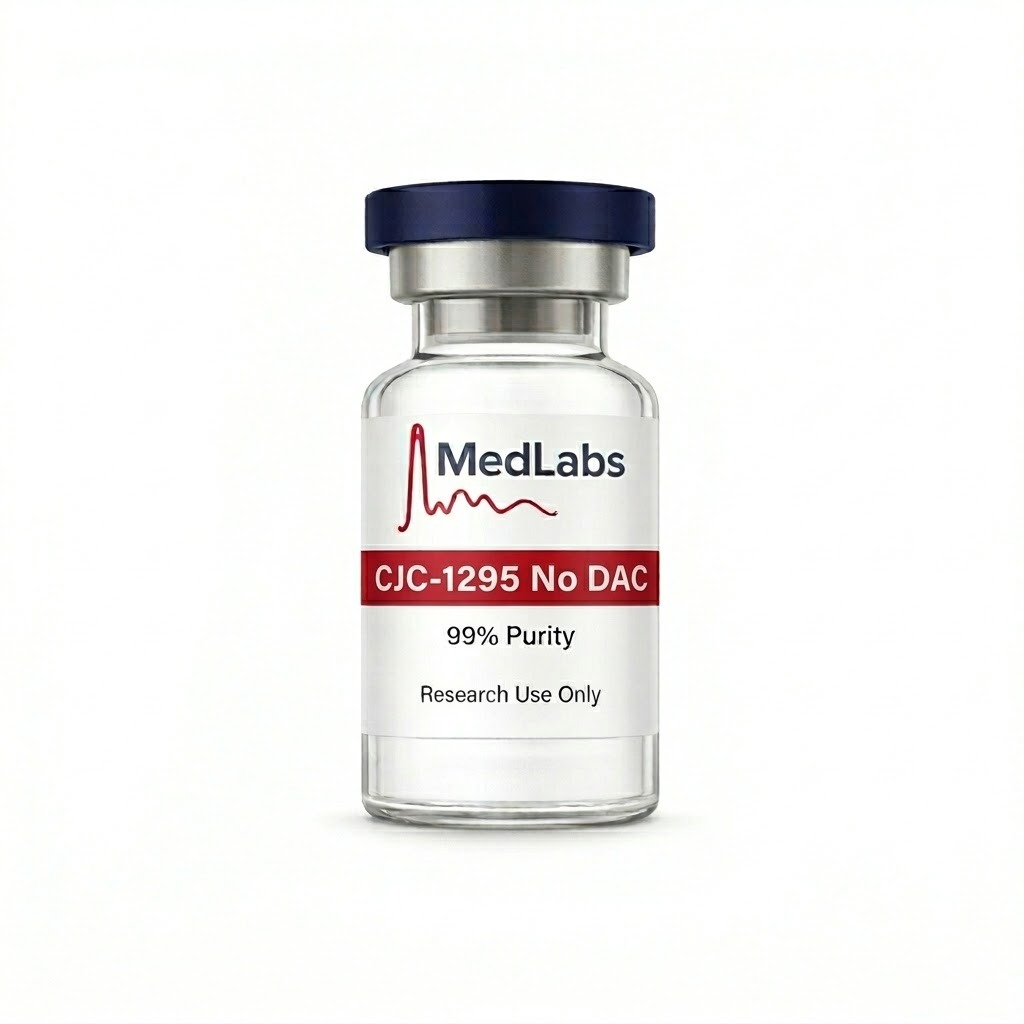
CJC-1295 No DAC (Modified GRF 1-29) – Research-Grade GHRH Analog for Pulsatile GH Studies
CJC-1295 No DAC, also known as Modified GRF (1-29), is a synthetic analog of growth hormone-releasing hormone (GHRH) engineered for laboratory research applications. Unlike its counterpart with DAC (Drug Affinity Complex), CJC-1295 without DAC features a shorter half-life, allowing researchers to study the natural, pulsatile release of growth hormone (GH). This makes it the preferred choice for investigating the somatotropic axis in models of metabolism, body composition, and endocrine function.
Key Research Benefits of CJC-1295 No DAC Peptide
Precision in Pulsatile GH Modeling
The primary advantage of CJC-1295 No DAC in a research setting is its ability to facilitate precise, controlled studies of the growth hormone axis. While CJC-1295 with DAC binds to albumin and creates a “bleed” effect lasting up to 8 days, CJC-1295 without DAC is cleared more rapidly, resulting in a half-life of approximately 30 minutes to 1 hour. This allows researchers to time the administration of the peptide to coincide with the body’s natural diurnal GH pulses (such as before sleep or after exercise), providing a more physiologically relevant model for studying GH secretion patterns. As detailed in comparisons by resources like Peptides.org, this specific CJC-1295 peptide variant is essential for experiments where mimicking natural endocrine rhythms is paramount.
Synergistic Research with GHRPs
CJC-1295 No DAC is most often utilized in research protocols that involve stacking with a Growth Hormone Releasing Peptide (GHRP) such as Ipamorelin or GHRP-6. CJC-1295 acts on the GHRH receptor to stimulate GH synthesis (cAMP/PKA pathway), while GHRPs bind to the ghrelin receptor to trigger GH release (calcium pathway). When combined, these two classes of peptides create a synergistic and robust GH pulse that is significantly greater than either peptide alone, making the “CJC/IPA” blend a cornerstone of in-vitro studies focused on muscle protein synthesis, fat metabolism, and tissue repair pathways. Researchers can find this blend available for laboratory use from suppliers like Peptide Sciences.
Stability and Controlled Parameters
Compared to endogenous GHRH, which is rapidly degraded by enzymes in the body, Modified GRF (1-29) has been engineered with amino acid substitutions to resist proteolytic degradation while retaining high receptor affinity. The absence of the DAC moiety ensures that the researcher maintains full control over the duration and intensity of the GH pulse. For research that requires repeated, predictable spikes in GH rather than a constant elevation, the CJC-1295 No DAC formulation is the gold standard.
Research Protocols & Usage Guidelines
Recommended Research Concentrations
-
CJC-1295 No DAC (Solo Research): 100 mcg administered in a pulsatile manner, typically 1-3 times daily.
-
CJC-1295 No DAC + Ipamorelin Blend: Common research concentrations are 100 mcg of CJC-1295 No DAC + 100-200 mcg of Ipamorelin per testing event.
-
Cycle Duration in Research Models: Research periods typically span 8-12 weeks, followed by a 4-week washout period to observe downstream IGF-1 dynamics and receptor sensitivity.
Reconstitution & Solubility
-
Solvent: Soluble in sterile water or bacteriostatic water for injection.
-
Appearance: White to off-white lyophilized powder.
-
Purity: Ensure research material is verified with HPLC analysis (≥98-99% purity).
Storage & Handling
Store CJC-1295 No DAC powder in a dry, dark environment. For long-term storage, maintain a temperature of -20°C (-4°F) or below. Once reconstituted with bacteriostatic water, the peptide solution should be kept refrigerated at 2–8°C (36–46°F) and used within 30 days to maintain research integrity. Avoid repeated freeze-thaw cycles
Frequently Asked Questions: CJC-1295 No DAC
What is the difference between CJC-1295 with DAC and CJC-1295 No DAC?
The key structural difference is the addition of a Drug Affinity Complex (DAC) to the end of the peptide chain. DAC allows the peptide to bind to serum albumin in the blood, dramatically extending its half-life to approximately 6-8 days. CJC-1295 No DAC lacks this complex, resulting in a short half-life (~30-60 minutes) that mimics natural GHRH pulses. For researchers, CJC-1295 without DAC is preferred for studying natural GH pulsatility, whereas the DAC version creates a sustained GH “bleed” that may lead to receptor desensitization in long-term models.
What are the primary research applications of CJC-1295 No DAC?
CJC-1295 No DAC is utilized in laboratory settings to study:
-
Somatotropic Axis Regulation: Understanding how GH and IGF-1 secretion are controlled.
-
Body Composition Models: Investigating lean muscle preservation and adipose tissue metabolism.
-
Sleep Quality and Recovery: Exploring the relationship between GH pulses and deep sleep architecture.
-
Receptor Cross-Talk: Analyzing the synergistic effects of GHRH and Ghrelin receptor activation.
Why is CJC-1295 No DAC often stacked with Ipamorelin?
CJC-1295 No DAC (a GHRH analog) and Ipamorelin (a GHSR agonist) are stacked because they work on two different receptors in the pituitary gland. This dual-pathway activation results in a more robust and physiologically significant release of growth hormone than either peptide can achieve independently. It is the standard research model for studying maximum GH amplification in controlled settings.
What are the common side effects observed in research models?
In research settings, common observations with CJC-1295 peptide administration include temporary injection site irritation, mild facial flushing, and occasional headache. These are typically transient and related to the vasoactive nature of GH release. Because CJC-1295 without DAC creates a pulse rather than a constant elevation, it is generally associated with a lower risk of prolactin elevation, cortisol spikes, or severe water retention compared to the DAC version.
Is CJC-1295 No DAC legal for research?
CJC-1295 No DAC is legally sold and purchased for in-vitro laboratory research and development use only. It is classified as an Investigational New Drug and has not been approved by the FDA for human use. It is also prohibited under the World Anti-Doping Agency (WADA) Prohibited List for athletic competition.
How should I store CJC-1295 No DAC to maintain stability?
Lyophilized (freeze-dried) CJC-1295 No DAC powder is stable for several weeks at room temperature during shipping but should be stored at -20°C (-4°F) or below for long-term preservation (months to years). After reconstitution with bacteriostatic water, the solution must be refrigerated and used within 30 days to prevent degradation
Additional information
| Strength | 5mg, 10mg |
|---|
Related products
-
HGH (Somatropin)
Price range: $55.00 through $145.00 Read more -
Ipamorelin
Price range: $40.00 through $60.00 Read more -
Buy GHRP-2 Online
$60.00 Read more -
HMG
$75.00 Select options This product has multiple variants. The options may be chosen on the product page
Reviews
There are no reviews yet.